
Every year, thousands of homeowners spend hundreds of thousands of dollars or more on their dream kitchen. New countertops, cabinets, appliances, doors, floors, and more. And almost no one in the renovation process, from the designer to the owners to the contractors are measuring the carbon being destroyed, preserved, or replaced along the way.
Considering 44% of all American homeowners are over the age of 60 (PDF) (despite being 29% of the population) and hold fully half of the country’s home equity, it’s likely in the next decade half of all American homeowners could be seniors. Further, as healthcare outcomes go, more seniors are aging in place, and when they eventually pass on, their homes are likely to wind up with their kids. Those homes are older, too, with 47% of America’s housing stock being built before 1980. And when new homeowners move in, more renovations happen.
Some of this is outflow from a big building boom in the 1970s. A 1973 Survey of Current Business article (PDF) describes a residential construction boom from 1970–1973 where new home starts rose from 1.5 million in 1970 to a record 2.4 million in 1972, with single-family starts rising from 815,000 to 1.3 million. Those homes are now over 50 years old. And they’re packed full of wood sequestering millions of tons of carbon. And when renovations start, a lot of that hidden carbon gets ripped out with it.
Take the kitchen cabinet, which is one of the most routinely discarded pieces of furniture in American life. In one 2026 kitchen survey, 68% of renovating homeowners replaced all their cabinets (PDF). Only 5% left the cabinets alone. Taken together, a lot of kitchen cabinets are destined for landfills in the next decade.
44%
of American homeowners are over the age of 60
A lot of kitchens are about to change hands.
47%
of America’s housing stock was built before 1980
Avocado-green appliances not included.
68%
of renovating homeowners replaced all their cabinets
Only 5% left them alone.
Perhaps no room is a better example of ways to be climate positive than the kitchen.
The Lowes Project Source Conway 36″ cabinet that stores as much as 116 pounds of CO₂
Let’s focus on the kitchen cabinets. They’re ubiquitous and almost always made of wood. In the United States, you can go to just about any Lowe’s and find the Project Source Conway 36″ cabinet, shaker-style, with white laminate, fully assembled, and ready to load in the back of the truck. They probably sell hundreds of these a week. It’s made of engineered wood, furniture board, and has a hardwood drawer box. All together, it’s 76 pounds.
Wood is roughly estimated to be 50% carbon by dry weight (most trees are 2/3 water), and the carbon inherently stored by the original tree is converted to CO₂-equivalent with the ratio of 44/12, or 3.67. Let’s also assume our cabinet is 8% moisture content and the dry weight of the wood, once you subtract out the metal hinges, laminates, resins, finish, and accessories, is about 63 pounds.
That means there’s 116 pounds of CO₂e stored in that one Conway 36″ cabinet (~53 kg). Or, about 32 pounds of pure carbon.
That is certainly not its total carbon footprint. The cabinet had to be manufactured, along with all its component parts. It has transportation costs and storage costs and the footprint of the retail store. Your drive to the store to look at it has a cost, too. Nothing is free!
All this just means that cabinet is quietly and dutifully holding on to about 116 pounds of CO₂e in its fibers. Like how your body is holding on to calcium in your bones.
Shake the cabinet piggy bank
Every wood cabinet is a little savings account for carbon. Tell us about yours and see how much your kitchen is quietly holding onto, then decide what happens to it next.
Not sure? A bathroom scale and a patient friend will tell you. The Conway 36″ from the story weighs 76 pounds.
Hinges, laminate, resins, and finish don’t count. The Conway works out to about 83% wood.
0 lb CO₂e stored
That’s about 0 kg of CO₂e, or 0 lb of pure carbon, roughly what a typical gas car emits driving 0 miles.
Now, what happens to these cabinets in the remodel?
Pick a path and see what happens to the savings.
A playful back-of-the-envelope estimate, not a lifecycle assessment. It uses the same method as this article: dry wood weight × 50% carbon × 3.67 to convert carbon to CO₂e. The driving comparison uses the EPA’s estimate of about 400 grams of CO₂ per mile for a typical passenger vehicle.
Cabinetmakers are counting this carbon, too
KCMA partners with ClimatePositiveNOW.org to promote sustainable, healthy materials
Comparing modern cabinetry to grandma’s kitchen cabinets
Grandma’s kitchen has those solid wood cabinets that feel like they were designed to crawl into as bomb shelters. They’ve held up to lots of sticky fingers, and, as dated as they look, they’re still a solid piece of wood. A kitchen cabinet from the 1950s and 60s were often built as long unitized assemblies rather than today’s individual, modular “boxes”. They often used wooden tracks for the drawers and had special cuts made for precisely fitting appliances and ovens.
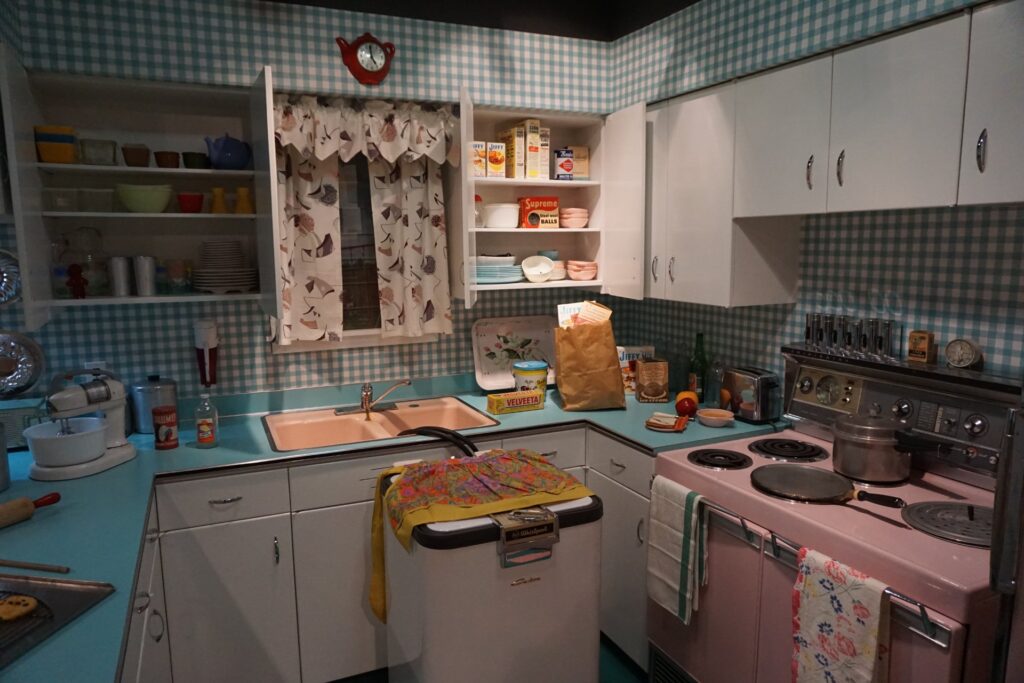

It’s not unlikely an older cabinet from this era likely could be storing around 80-100 pounds of carbon.
It is true that more modern cabinets can use less wood. This is not to mean they are “cheap”, just that they’re using newer techniques. Press and particleboard products can be fantastically rigid and sturdy. But because wood is about 50% stored carbon, having less wood means newer products store less carbon than cabinets from 40+ years ago.
To be clear there are still plenty of “heavier”, thicker solid wood cabinets available today, both in big-box retailers, global brands, and local craftsmen. The best thing you can do as you choose new cabinets is to avoid the temporary, cheaper, short-term, fashionable fix. You’ll help the environment more by investing a little more now to create a more durable, 30-year kitchen than replacing it again in 10 years.
It’s time to specify a climate positive future
And as solid and well-built as those face-frame “unitized” cabinets were from the 50s and 60s, they’re not easily repurposed. Modern “modular” cabinet units, most of which started to become popular in the 70s and 80s, can be relocated as smaller parts. They’re also easier to donate. Which brings us to what to do with the waste.
America’s expanding wasteline
Kitchens keep getting bigger in most American housing markets. A typical kitchen grew from roughly 120 sq. ft. in the 1960s, to 150 sq. ft. in the 1980s, to around 175–200 sq. ft. in today’s homes. That’s an additional 250+ sq. ft. in new, open-plan construction. This tracks with growing home sizes, as the Census pegs single-family homes around 1,800 sq. ft. in the 70s and 80s. The average today is about 2,436 sq. ft.
Honey, I grew the kitchen
Typical kitchen size over the decades, roughly to scale. More square footage means more cabinets, more counters, and more wood in play every time a remodel comes along.
1960s
About 120 sq. ft.
1980s
About 150 sq. ft.
Today
About 175–200 sq. ft.
The whole house grew too: about 1,800 sq. ft. in the 70s and 80s, about 2,436 sq. ft. today.
While older homes may not have the footprint to support a kitchen expansion, many can. Or, at least, many will get renovations to make use of the space they have. All those renovations result in a turnover in the carbon footprint of a kitchen. The cabinets, millwork, countertops, and flooring only has four places to go:
- “Smash and replace” renovations where wood is pushed to landfills
- Refinishing or refacing
- Removal and donation
- Moved elsewhere, like to a garage or laundry room for further use
Architectural waste is about 1/3 of all North American landfill volume. Leaving the kitchen in place doesn’t mean living with the old kitchen. Demolition and landfills should be avoided where possible, but sometimes it is our only reasonable choice. Throwing the wood into an incinerator or landfill wastes the labor and material invested in it, and ends the wood’s useful life. The whole renovation resets a massive carbon clock as a result.
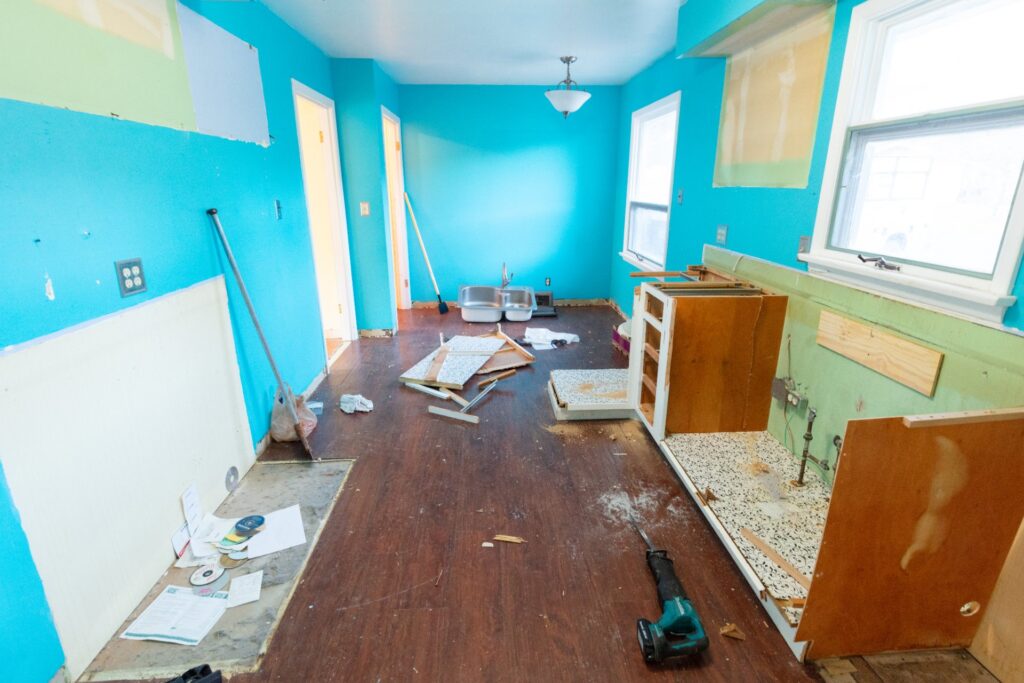

Ecologically, try to donate whatever’s reasonably useful. If possible,
- Make an effort to remove cabinets without smashing them to smithereens for sake of ease.
- Repurpose old cabinets into a garage for storage or as laundry room utility cabinets.
- New finishes or paints and hardware can make these look great with a vintage, rustic aesthetic many people adore.

Beyond kitchen storage for carbon storage
Beyond cabinets, there’s wood flooring, wood panels, wood millwork and decorative elements like crown moulding, and wooden countertops that offer significant carbon storage. Preventing these elements from reaching landfills or burn piles prevents the carbon clock from resetting in your kitchen. As long as the wood is in use, it’s storing carbon.
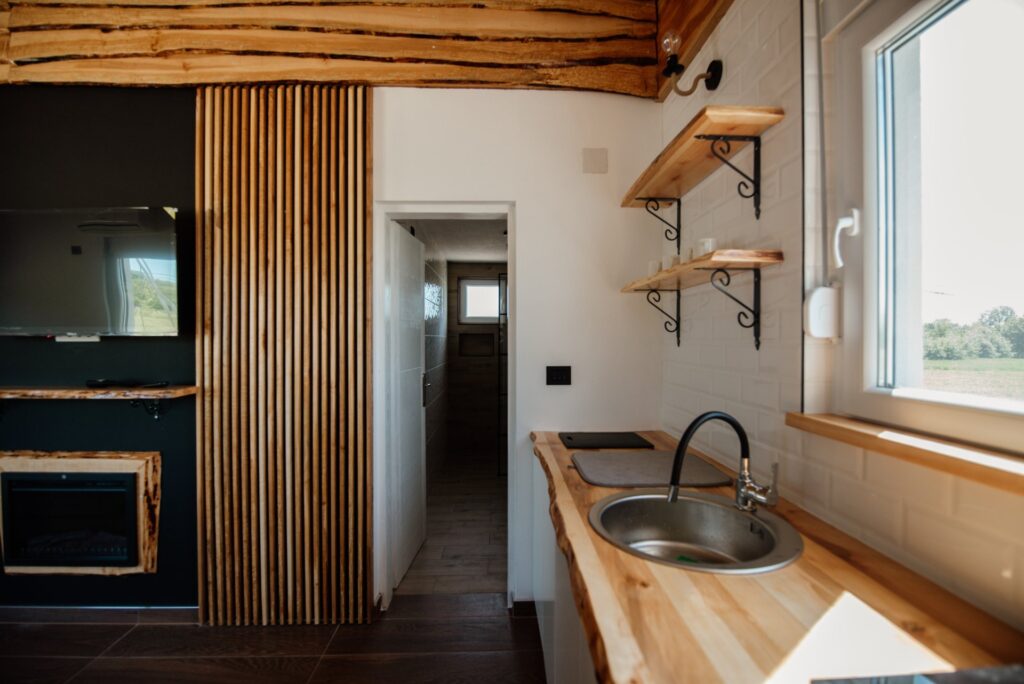

- Wood floors, assuming they are in good shape, can be covered over.
- Butcher block countertops can be sanded and re-varnished in some cases.
- Or, consider adding a wooden countertop in lieu of granite or stone, which is always a net negative in carbon due to its manufacturing and logistics. If you need another reason, NIOSH says engineered stone countertop fabricators are at risk of silicosis because engineered stone often has very high respirable crystalline silica content, typically over 90%.
- Alternatively, consider how you might repurpose a wooden countertop as a work bench, outdoor storage table, or craft table.
Replacing the floor anyway?
Three sustainability benefits of laminate flooring made from responsibly harvested wood
The most climate-positive thing you can do now in a kitchen renovation is ask yourself: what in here is still “alive”? And how do we keep it that way?
Is it still alive in here?
Click around this kitchen before the demo crew does. Each glowing dot is something you’ll have to decide on, and plenty of it is still storing carbon.
Tap a glowing dot
Cabinets, counters, floors, trim, and hardware all have a next chapter, and some are better candidates than others.
You’ve checked 0 of 8 things.
Your kitchen renovation release plan
- Measure all the widths, heights, and depths of the possibly reusable woodworking. Anything that’s organic. This way you can measure potential new use scenarios later.
- Anything that’s failing, like cabinet backs, damaged particleboard, or moldy bases gets thrown away.
- Recycle all the metal, like doors and handles and hinges.
- As you renovate, protect what’s reusable from the rain and humidity if your staging area is outdoors.
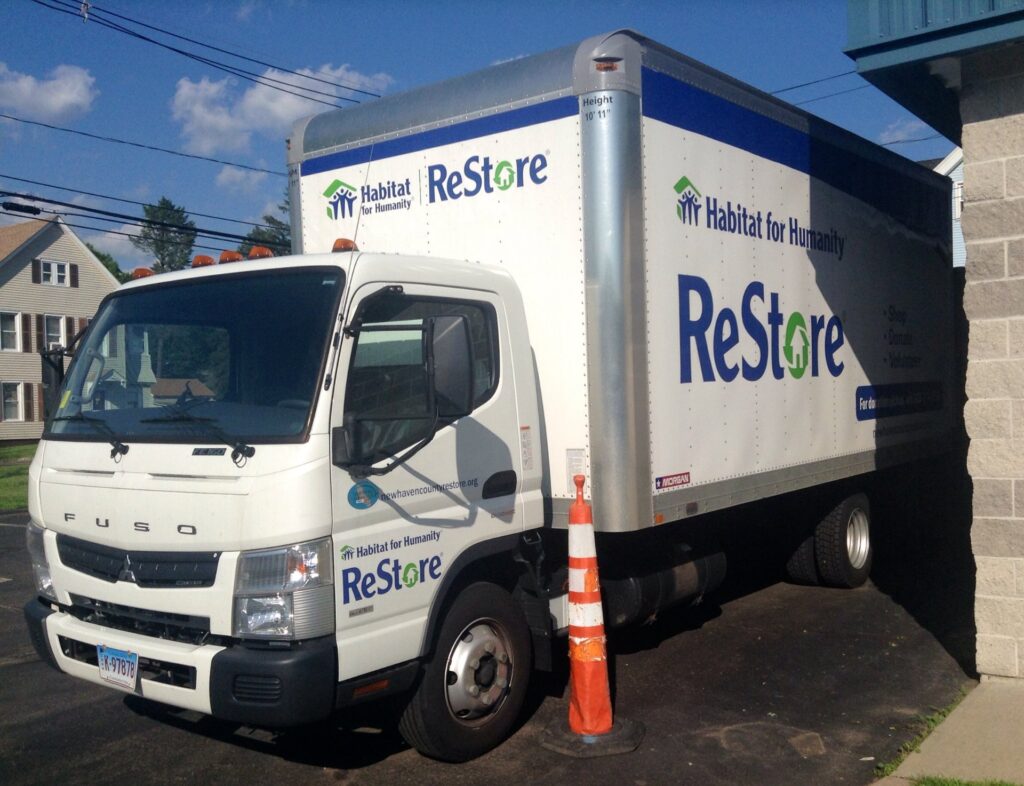
- Label pieces that go with specific items for donation to Habitat for Humanity or ReStores. Simply placing screws in a sandwich bag taped to the component with corresponding numbers helps ensure reuse later.
Before the dumpster arrives
If you’re removing old stone or laminate flooring or countertops, call your local donation center first. Many donation centers have to reject these pieces because they’re cut to size (like for sinks or stoves), lack hardware, or are just really hard to re-home.
Ask your contractor these questions, too
- Will you remove cabinets intact, or is demolition assumed?
- Is there a line item for deconstruction labor?
- Can we schedule a salvage pickup before demo?
- Can you help me repurpose some items elsewhere around the house?
- Will reusable wood, metal, appliances, and hazardous materials be separated?
- Who owns removed materials — me, the contractor, or the hauler?
- Can you protect cabinets from rain after removal?
- Do you work in pre-1978 homes under lead-safe practices?
- Do you test suspect flooring, mastics, or ceiling materials before disturbing them?
Bring these to your next walkthrough. Contractors love a client with a list. (Mostly.)
Email them to myselfAnd as you renovate the kitchen, remember that wood is the single best sustainable building material we have.
Keep reading
Caron Thinks Green
Quebec’s Caron Industries on cabinets that store carbon, and why it joined the movement.
Designers are still looking for something better than wood?!
Jon Strassner, former Chief Sustainability Officer for the ASID, on wood and “The Carbon Denominator.”
Stop Making Sustainability So Complicated
Why “climate positive” is a clearer way to say carbon negative.